Congress Considers Leasing the English Language to Big Tech
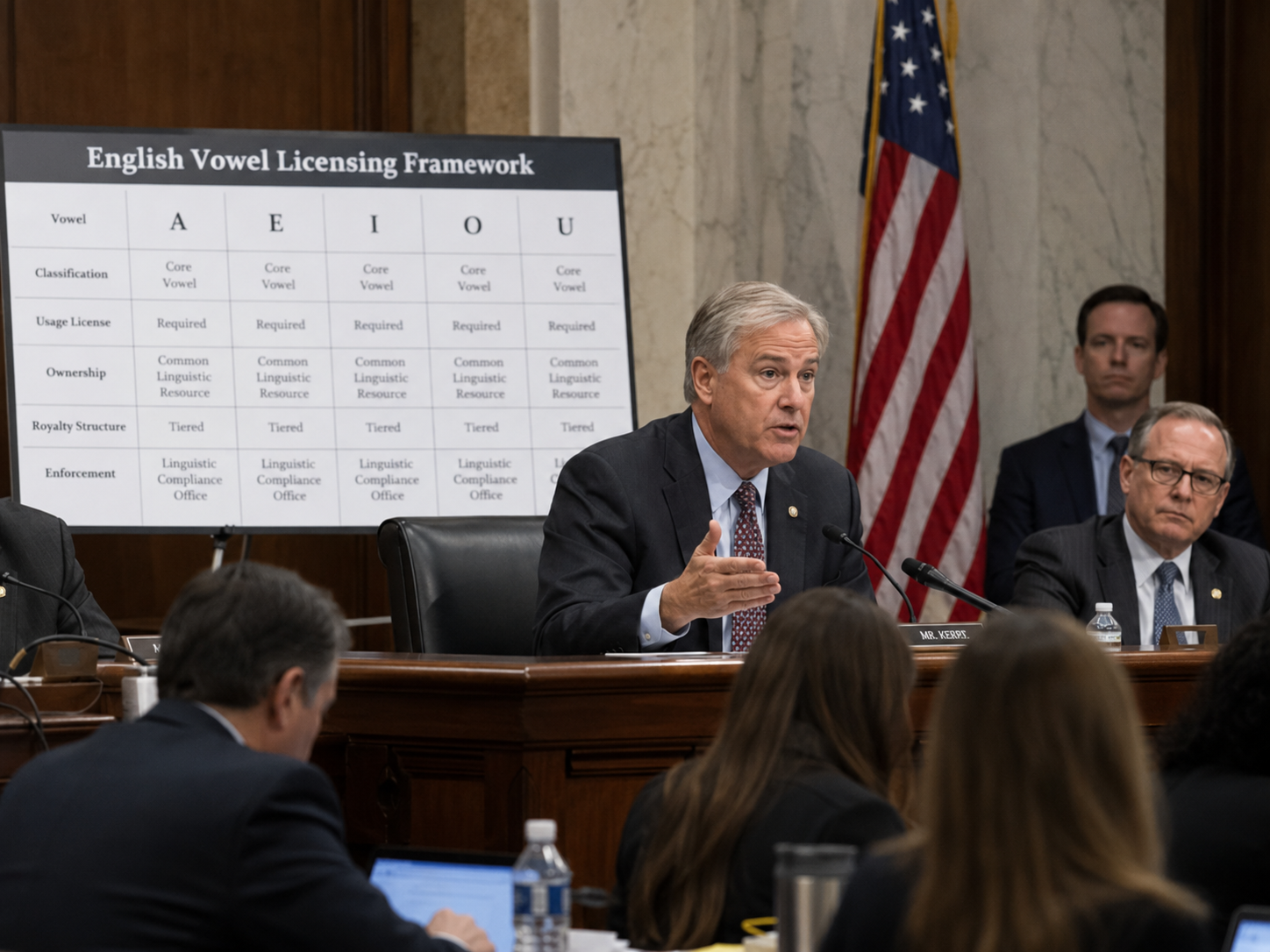
Reuters / The Ivan Von Noshrilgram Foundation
By IVAN VON NOSHRILGRAM JR. & ALISTAIR A. VOGAN
Estimated reading time: 6–8 minutes
WASHINGTON, DC - This week, Clearview AI, Google, Amazon, and several firms that describe themselves as “language-adjacent” disclosed their recent deliberations with the Library of Congress in Washington and the Senate Subcommittee for Literacy Reform over the legal right to purchase and indefinitely possess the copyright of English vowels.
Senator Ralph Skinner, who, until recently, spearheaded the Senate subcommittee, reported in the Washington Post on Friday that the proposal included all vowels. Later that evening, however, he was forced to back down from this claim, stating, "In fact, it will be the five 'power vowels,’ that is, ‘A’, ‘E’, ‘I’, ‘O’, ‘U’, and, unfortunately, only sometimes ‘Y’.” Those present said he looked sad as he added the final phrase.
Samsung, Facebook, and Apple have also announced that they are investigating the copyrighting of the hard consonants, 'K’, 'T’ and 'B’, which, some say, while counter-intuitive, makes economic sense. Mr. Skinner, though no longer officially speaking on behalf of the Senate Subcommittee for Literacy Reform, has pointed out that the American government has a clear fiduciary duty to the American public.
"Americans expect our actions to be in agreement with our stated aims. We’ve said we’ll balance the budget. Let’s show them how to do it!” Skinner was quick to state that the present negotiations only concern the American alphabet and will not "in any way” affect its trading partners. "That’s a promise, Canada!” Skinner said, giving two thumbs up to a webcam that, according to staffers, was not turned on.
Enthusiastic supporters of the proposal believe this will provide a real and much-needed boost to the economy—though no one has yet stepped forward to explain how. Still, a pay-as-you-go plan has been proposed that would make the vowels, and possibly in the future, the hard consonants, if not the entire alphabet, available to the American public, for an affordable price.
It is speculated that the top 0.1% will choose a one-time fee that could be extended one or more generations, with premium households receiving early access to diphthongs, silent letters, and certain emotionally resonant uses of “O.”
A spokesperson for Jeff Bezos of Amazon assures the public that rates will be very competitive:
"We’re on the public’s side with this one.”
Those familiar with the proposal describe it as part of a broader national effort to help Americans get more for less: more connection with less confusion, more expression with less disorder, more participation with less shouting, and, in time, more democracy with fewer costly outbreaks of unlicensed speech.
Early briefing documents call this “the responsible optimization of expression,” a phrase several officials reportedly found moving.
Secretary of Education, Linda McMahon, stated that the proposal could help fund much-needed services still affected by what officials describe as “several recessions, a pandemic, inflation, platform instability, and the general difficulty of teaching children to read while explaining to them that letters are now subscription assets.
“This will absolutely help fund public schools still affected by Obama’s Great Recession,” McMahon said.
She speculated that lower-income families would initially receive subsidies to continue using the language outside of such public institutions, though only during approved daylight hours and within a reasonable character limit.
“Americans. Your voices matter to us.”
Obviously, an element of trust and good citizenry will be expected, at least until the latest artificial-intelligence monitoring technology is in place.
Detractors point out that all of this is akin to the great land grab of the 1800’s, except with more terms of service. In addition, critics argue that implementing the proposed reform will be next to impossible—and cost taxpayers millions.
"And anyway,” states Dr. Biba Von Noshrilgram of The American Voices Project, “access to language is a fundamental human right. The alphabet belongs to everyone, doesn’t it?”
"Nope,” said Bill O’Reilly, former host of The O’Reilly Factor, and one of the proposal’s staunchest supporters during what observers described as a spirited cross-platform exchange with Amy Goodman of Democracy Now!.
"Did you invent the English language?” he asked Amy Goodman.
"No,” he answered for her.
"And, I suggest, Amy, that if you are using it, just as I am, admittedly, then you are in a position akin to squatting. …Unless you pay for every phoneme you consume.”
"I’d say I’m speechless, Bill,” Goodman reportedly replied, “but I’m sure that would cost me more than I could afford.”
"Actually, that’ll be a dollar fifty, Amy,” said Mr. O’Reilly.
"No one has purchased the vowels yet, Bill,” clarified Ms Goodman.
"And if you don’t own them,” Mr. O’Reilly continued, “but you use them, and you don’t pay, don’t be surprised if there’s some form of legal action. The free ride is over! And don’t come crying to me, or anyone else, unless it’s with consonants exclusively. If bleeding hearts have a problem with this proposal, heck, I say go and invent your own language!”
"…Or go back to their own country?” it is reported Amy Goodman added.
"Sure, Amy. That’s fine with me.”
"I don’t like it, Bill,” she continued, “And I’m American.”
"Amy, it needs to be stated. In the end, the alphabet has gotta be regulated. It’s that simple. We need to know where it is and how it’s being used, all the time, for national security reasons. Outside of book sales, publishing, search, social media, voice assistants, predictive text, AI training data, smart devices, school curricula, government forms, legal documents, medical records, poetry, protest signs, wedding vows, apology texts, and the phrase ‘I have read and agree to the terms and conditions,’ no one really know what the vowels have been up to.”
"Alphabet says it has been concerned for some time,” Goodman added.
"…I’m sure they have, Amy.”
Editor’s Update: This article has been updated to reflect subsequent statements from companies wishing to clarify their relationship with human expression.
Meta has also expressed cautious interest in the proposal, noting in a written statement that it supports “responsible language innovation,” provided the final regulatory framework allows users to share meaningful life updates, personal milestones, unverified political theories, restaurant complaints, and photographs of themselves standing near wings painted on walls.
Clearview AI, meanwhile, said it was “unable to comment on ongoing negotiations,” but confirmed that, if granted access to vowel-usage records, it would deploy the technology only in cases involving public safety, national security, internal research, contractor partnerships, product development, historical preservation, synthetic training environments, and “other limited circumstances as required.”
Asked whether citizens would be permitted to opt out of vowel monitoring, a company representative paused for several seconds before saying, “I know this is awkward. Could you repeat the question without vowels?”
At press time, the Senate Subcommittee for Literacy Reform had adjourned after several members were unable to complete the phrase “We the People” without exceeding their provisional character allowance.
Alistair A. Vogan is a writer, educator, and transdisciplinary thinker whose work explores the strange, funny, and often uncomfortable systems shaping human behaviour, technology, learning, and culture. His forthcoming nonfiction book, Please Make Yourself (Un)comfortable, blends narrative, cognitive science, evolutionary biology, complexity theory, and humour to examine how life’s drive to get “more for less” shapes everything from cells and consciousness to cities, innovation, and the beautiful absurdities of modern life.
***
This excerpt is from
By Degrees The Gentlest Asinine Expression
AVAILABLE AT
BARNES & NOBLE Indie Bound Abe Books UK Alibris AMAZON Book depository
Better World Books MAGRUDY'S Abe Books KINOKUNIYA..
WHILE COPIES LAST...
Hey now. Share this with your world, you gorgeous super influencer.
Alistair A. Vogan is a researcher, writer, educator, and transdisciplinary thinker whose work explores the strange, funny, and often uncomfortable systems shaping human behaviour, technology, learning, and culture. His forthcoming nonfiction book, Please Make Yourself (Un)comfortable, blends narrative, cognitive science, evolutionary biology, complexity theory, and humour to examine how life’s drive to get “more for less” shapes everything from cells and consciousness to cities, innovation, and the beautiful absurdities of modern life.
Copyright (2026)