The Scrambled-Eggs Theory of Justice
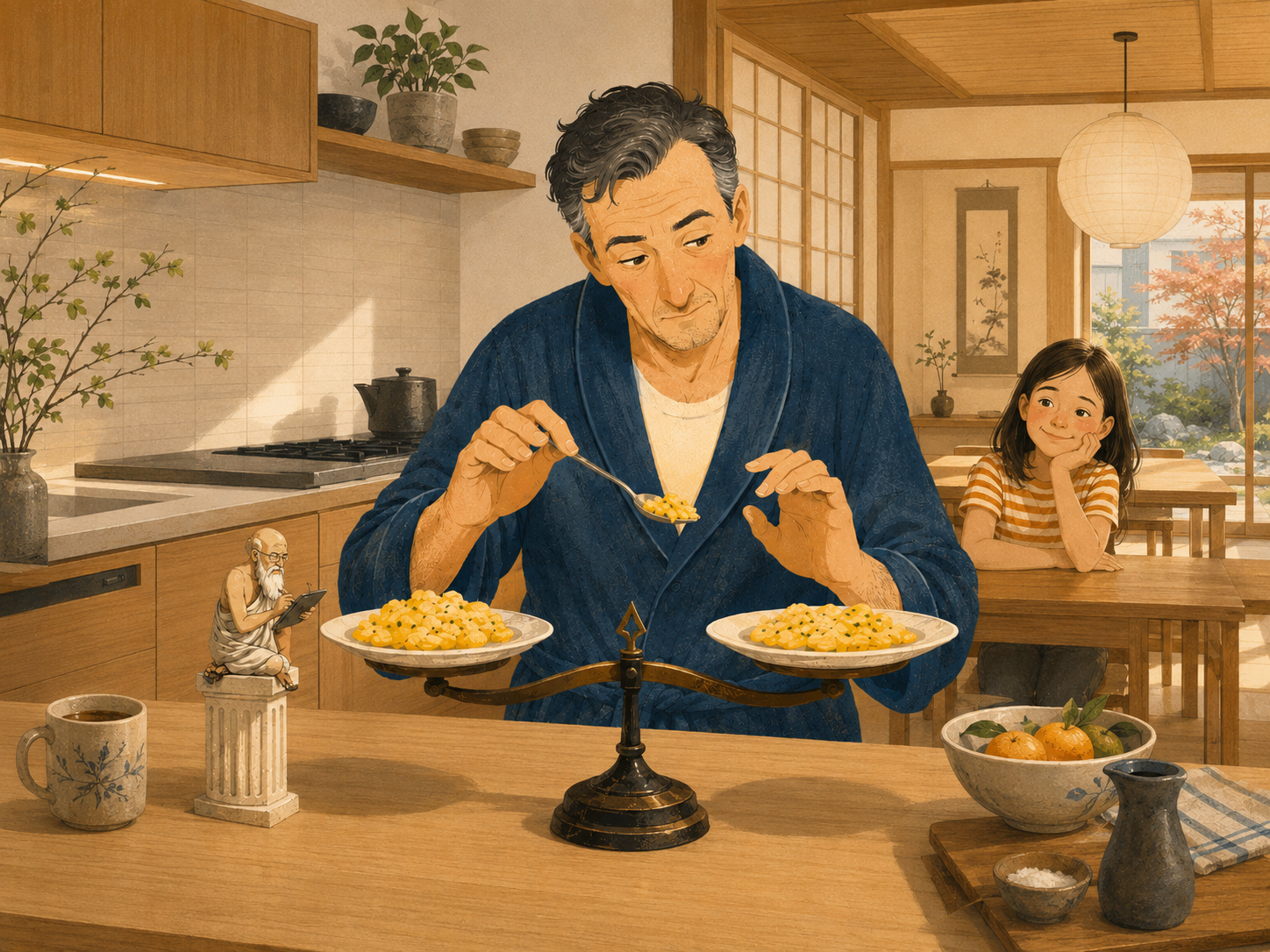
A father, two plates of scrambled eggs, and one tiny ancient accountant inside the skull.
One of the quiet privileges of being a father is the conviction that you know exactly what you're doing right up until the moment you discover that—heck—you don't.
Take breakfast. And Dad’s Famous Scrambled Eggs.
If there is one task for which a middle-aged dad should be uniquely qualified, it is dividing Dad’s Famous Scrambled Eggs between just two plates. This is not neurosurgery, folks. This is not international diplomacy. It’s breakfast.
And yet—yet!—one morning before 7 a.m., before my requisite four espressos, standing alone in my kitchen with two plates and a finite quantity of scrambled eggs, I found myself confronting a problem that turned out to be far stranger than it had any right to be.
The assignment seemed simple.
One serving for me.
One serving of equal size for my daughter, whom I love dearly.
Civilization has solved harder problems, admittedly. We have split the atom (though I wasn’t there), mapped the human genome (busy that day), and somehow persuaded millions of people to spend their evenings watching strangers unbox kitchen appliances on YouTube. (Okay. I’m back! Just checking something, a thing, on YouTube!)
Surely I could divide breakfast fairly. In fact, it is easy. Why would anyone overthink it?
So I began—to divide the scrambled eggs equally.
A little more on one plate. Just a little less on the other.
Equal.
Then I stopped.
Something felt off.
The serving of scrambled eggs intended for my daughter suddenly looked … larger.
Not objectively larger. It felt larger.
And mine felt smaller. Definitely. Smaller in the peculiar way that a parking space begins to feel as you attempt to slide your car into it while strangers watch. Smaller in the way last year’s bathing suit feels the first time you put it on this year. Okay. Maybe that’s a bad example.
I moved a lump of scrambled eggs from her plate to mine—paternally.
There. Equal! 100%!
Perfect.
Then, to be extra safe, I tried something dangerous: I imagined receiving her plate.
Now my new plate—her old plate—seemed suspiciously inadequate.
I shifted something back, feeling more and more like Buster Keaton.
Perfect.
Then it wasn't. Hers was just fine, until it was mine. Then it seemed smaller…
For what felt like too long, I stood there conducting what can only be described as a one-man fairness hearing.
I was the judge.
I was the jury.
I was the defendant.
And increasingly, I suspected I was also the culprit.
The strange thing was that I genuinely wanted the portions to be equal. Of course. Right?
Not that that needs to be said. …Does it?
There was no conscious scheme unfolding in the background. No secret plan to exploit my daughter through aggressive breakfast acquisition. There was no system at work here. …Or was there?
Every time I looked at my portion of the scrambled eggs, it looked exactly right.
And every time I imagined my daughter receiving that very same portion, it suddenly seemed a little too large.
Not dramatically.
Just enough.
Enough to move one more piece of food.
Enough to justify one more adjustment.
Enough to make me wonder whether fairness itself was somehow changing shape.
It was as though my brain had appointed itself Commissioner of Equity and was quietly siphoning resources into an offshore account. That sort of “fair.”
The discovery was unsettling.
Not because I wanted more breakfast.
Because I didn't.
What bothered me was something deeper:
The world itself seemed to be changing in front of me, depending on whose perspective I occupied.
The scrambled eggs hadn't changed. They weren’t conspiring.
The plates hadn't changed. Plates—come on. They’re dumb.
No. Only the point of view had changed.
And yet the proportions themselves appeared different.
That is a peculiar thing to notice before coffee.
Most people would laugh, make a final adjustment, and move on with their day.
But once you've seen something like this, it becomes difficult to ignore.
Because hidden inside an ordinary breakfast is one of the deepest questions in cognitive science:
What if perception is not a camera pointed at reality?
What if perception is a negotiation?
Psychologists have spent decades studying situations remarkably similar to my breakfast dilemma.
In experiments known as the Dictator Game and the Ultimatum Game, participants are asked to divide resources between themselves and others.
Again and again, leading figures in behavioral economics and decision research, including Daniel Kahneman, Jack Knetsch, and Richard Thaler, observed the same pattern.
Here it is: people will redefine fairness in ways that just happen to benefit themselves.
The fascinating part is not the bias.
The fascinating part is the sincerity. The perception may be unconsciously motivated; the reasoning often arrives afterward, carrying a clipboard and pretending it was in charge all along.
The point here is people generally do not experience themselves as cheating.
They experience themselves as being fair.
Fairness, it turns out, is surprisingly elastic.
Like the waistband of a pair of pants in late December.
Researchers call this phenomenon a self-serving bias.
But that phrase somehow feels too small.
A self-serving bias sounds like something a used-car salesman might possess.
What happened in my kitchen felt more, er, fundamental?
Reality seemed to change. The food itself appeared different.
And the perception of equality, which was being tested at that moment, shifted depending on who stood to gain.
Harvard philosopher John Rawls, author of A Theory of Justice (1971), built an entire theory of justice around this problem.
His famous “veil of ignorance” thought experiment asks us to design a society without knowing what position we ourselves would occupy within it.
We might be … rich or poor.
Healthy or sick.
Powerful or powerless.
The idea is simple.
Without knowing which position we will occupy, we are more likely to create rules that are genuinely fair.
In other words, fairness requires perspective rotation.
And standing in my kitchen that morning, I realized I was performing a crude version of Rawlsian political philosophy using scrambled eggs that were slowly moving toward room temperature—though this isn’t a rationale for more scrambled eggs next time.
The point is that every time I mentally stepped into my daughter's position, my perception recalibrated.
Reality seemed to change.
Not because reality had changed.
But because I had.
And that realization points toward something much larger.
Larger than breakfast, even.
Larger still than fairness.
Perhaps even larger than consciousness itself.
For centuries, we have imagined perception as a process of gathering information about the world.
But increasing evidence suggests something different.
Perception may not have evolved to show us reality as it is.
It may have evolved to show us reality as it matters to us. And because resources shape survival, perception may be especially sensitive to anything that changes what must be spent, saved, risked, or gained.
A hill is not merely a slope.
A hill is an energetic cost.
A relationship might be defined as “close” or “distant.” The point is the distance.
And so a relationship carries effort.
A problem is not merely complicated.
A problem is heavy.
Notice how naturally the language arrives.
Heavy topic.
Weighty matter.
Close friend.
Warm person.
Cold shoulder.
Draining conversation.
Refreshing idea.
Burnout.
Exhaustion.
Human beings often seem incapable of talking about life without referring to one thing: energy.
How much, in the end, does it cost us? A heavy topic feels like a heavy object: something that requires more calories, more energy, to move. A close friend can be reached figuratively, without expending much energy to get to them. A warm person will not deplete your energy reserves in the way heat travels from a hot object to a cold one. A draining conversation can leave those valuable reserves diminished. And so on.
It's as though buried inside our language is a lesson our biology has been trying to teach us all along.
That lesson sits at the heart of my narrative nonfiction work, Please Make Yourself (Un)comfortable, a genre-blurring journey through evolutionary biology, cognitive science, complexity theory, and cultural history. The book argues that life is shaped by a biological imperative to get “more for less”: to conserve energy, capture value, and, importantly, transform scarcity into possibility.
Indeed, every living thing faces the same fundamental challenge:
How do we acquire, preserve, allocate, and invest our limited energy? Once we have it, how do we limit its expenditure? In the bargain, what is lost, and what is gained?
The details change.
The technologies change.
Civilizations rise and fall.
But the underlying problem remains.
Perhaps that is why so many of our deepest metaphors revolve around warmth, weight, distance, effort, contamination, flow, depletion, and renewal.
Not because language is poetic.
But because life is energetic.
And perhaps, without realizing it, we have been speaking the language of energy all along.
A few minutes later, my daughter wandered into the kitchen.
“Good morning!”
“Good morning, super kid.”
I handed her breakfast as she sat down.
Then I sat down.
Neither of us said anything for a moment.
I glanced at her plate.
Then at mine.
Then back again.
Everything looked perfectly equal.
Or at least equal enough.
Which, under the circumstances, felt like a remarkable achievement.
Not because I had solved breakfast.
Not because I had defeated bias.
But because, for a brief moment before I’d had my requisite four espressos, I had caught a glimpse of the tiny ancient accountant operating somewhere inside my skull—the one evolved in scarcity, still auditing resources on behalf of a species that spent most of its history one failed hunt away from starvation.
I took a bite.
The accountant reviewed the numbers.
Paused.
Then, with visible reluctance, he approved the transaction.
Enjoyed this excerpt from Please Make Yourself (Un)comfortable: The Rogue Scientist’s Field Guide? Don’t worry. Support options are coming soon. For now, the best way to help is to share it with one dangerously thoughtful person.
Go on, share this with your world, you gorgeous super influencer.
Alistair A. Vogan is a researcher, writer, educator, and transdisciplinary thinker whose work explores the strange, funny, and often uncomfortable systems shaping human behaviour, technology, learning, and culture. His forthcoming nonfiction book, Please Make Yourself (Un)comfortable: The Rogue Scientist’s Field Guide, blends narrative, cognitive science, evolutionary biology, complexity theory, and humour to examine how life’s drive to get “more for less” shapes everything from cells and consciousness to cities, innovation, and the beautiful absurdities of modern life.
#AlistairAVogan.com #PleaseMakeYourselfUncomfortable #PleaseMakeYourself(Un)comfortable
Alistair A. Vogan Copyright (2026)