The King Midas Problem: How Modern Civilization Optimized Itself Out of Life
Or, The Second Law of Thermodynamics Doesn't Care About Semiotics
There is the old Greek myth you are almost certainly familiar with about a great king who accidentally invents modern civilization.
His name is Midas.
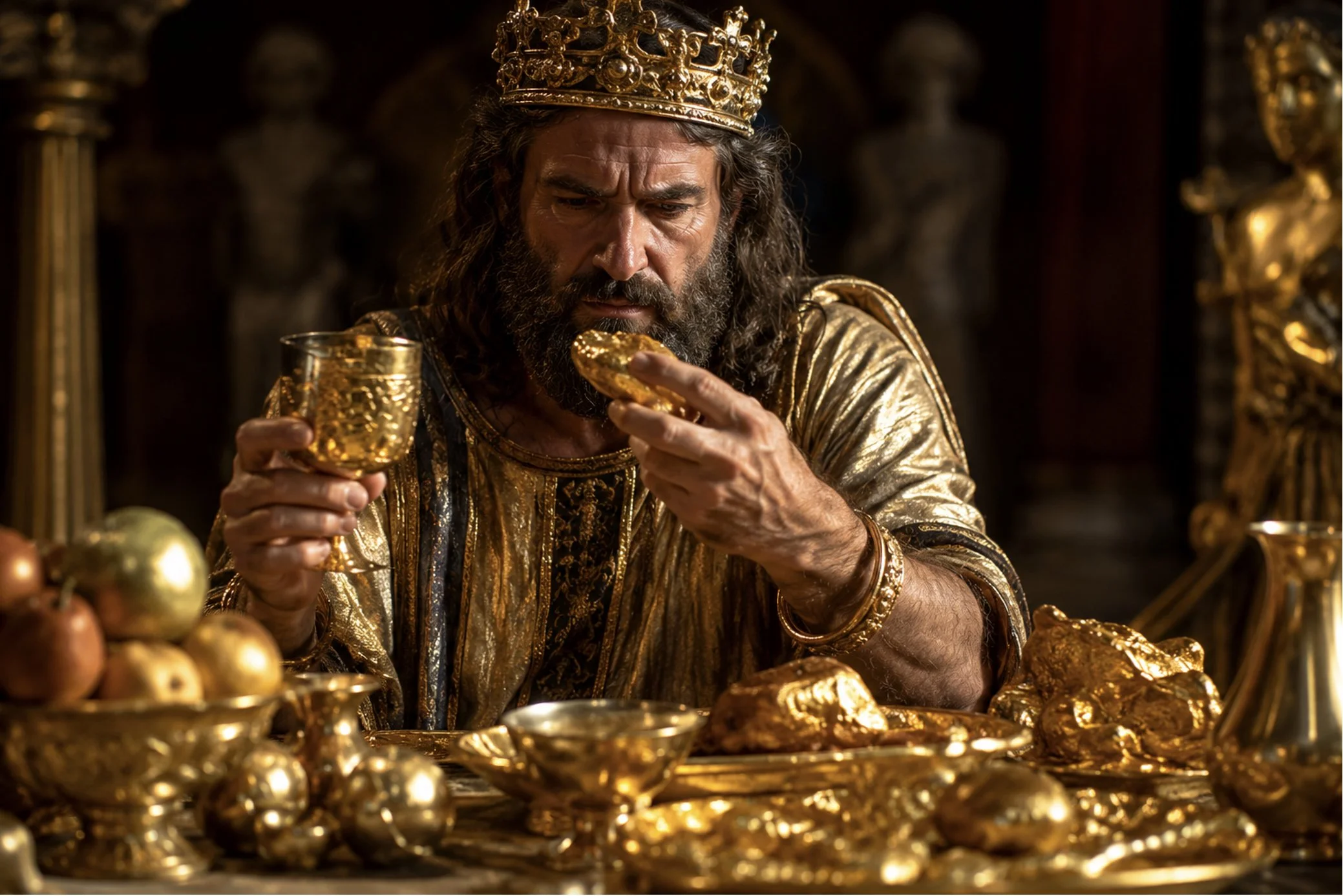
Most people simply remember the punchline. A greedy king is granted a wish by the gods. He asks that everything he touches turn to gold. At first, this seems marvelous. It is wish-fulfilment, dialed all the way up to 11. Tree branches become golden sculptures. Furniture gleams. Walls shimmer. The king, short-sighted, laughs at his own genius.
“It’s so easy!”
And then, of course, lunch arrives.
The bread hardens into metal while he chews. Wine becomes molten wealth. In later retellings, still jubilant, he embraces his daughter and transforms her into a statue.
In modern usage, we even speak admiringly of “the Midas Touch,” as though it means no matter what some particular individual does, it all works out brilliantly.
But the truth is darker. At the very least, it is what Sigmund Freud would have recognized as an expression of Thanatos: a death wish. From a modern perspective, it is more like a murder-suicide.
The moral, we are told, is simple:
Greed is bad.
But the Greeks, true masters of irony, almost never told simple stories, did they?
The strange thing about the enduring myth of King Midas is that gold itself is not actually the problem. Gold is merely the carrier signal. The real subject of the story is energy, and its problematic proxy: power.
More specifically, it is about what happens when human beings begin confusing symbols of power with power itself.
This confusion may be the oldest recurring software bug in civilization.
To understand why, it helps to sail from ancient Greece for a moment and pull our boats up on a bank of the Sangarius River in west-central Anatolia—modern-day Turkey—nearly three thousand years ago.
The real King Midas (Mita of Mushki in the annals of Assyrian King Sargon the Second) likely ruled the kingdom of Phrygia sometime during the eighth century BCE. His capital, Gordium, sat astride crucial trade routes linking West and East, specifically Lydia in western Anatolia, and the powerful and wealthy Assyria, and the sacred and culturally rich Babylonia.
This worked out well for him.
To the Greeks, Phrygia represented exotic luxury: elaborate textiles, impossible wealth, strange music, old dynasties. It occupied the same psychological territory that modern Dubai, Silicon Valley, or Wall Street in the 80s might today — dazzling, sometimes sophisticated, and faintly suspicious.
And gold mattered.
Boy, did it matter.
Not because gold feeds anyone. It does not. You cannot eat it, drink it, burn it efficiently, or build civilizations from it directly. Gold is almost biologically useless. That is precisely why humans value it. It does not decay. It resists corrosion, and, seemingly, the Second Law of Thermodynamics. Yes. It survives time itself.
Gold became, in effect, compressed symbolic permanence.
Which makes Midas’s wish much stranger than it first appears.
He is not asking for riches, really.
He is asking for the ability to convert reality itself into symbolic abstraction.
And this distinction is important.
Because living systems do not survive on static symbols. Entropy does not care about semiotics. Living systems survive on flows.
A forest survives on the movement of sunlight into sugars, sugars into tissues, tissues into ecosystems. Animals survive through dynamic exchange — oxygen, heat, water, metabolism, information. Civilizations themselves are gigantic energetic machines, converting matter into ever greater order through continuous circulation, and what Jeffery West at the Santa Fe Institute points out: the existence of sublinear scaling laws.
Life is not storage.
Life is throughput.
And yet humans possess a peculiar and magnificent cognitive tendency, as we know. We create abstractions to reduce complexity to minimize energy expenditure. And so, money simplifies barter. Language simplifies experience. Metrics simplify judgment. Prestige simplifies social navigation.
It is the dark side of what we have called the Prime Directive.
To be clear: symbols are compression technologies. They allow the brain to achieve more while expending less energy—a phenomenon that has been, naturally, evolutionarily advantageous.
Abstraction is one of humanity’s great superpowers, as AI and software engineer François Chollet explores in his work, On the Measure of Intelligence.
It is also a double-edged sword, where the trouble begins.
Why? Because eventually, the nervous system forgets the difference between the symbol and the thing the symbol represents. Fiction decouples from reality, just as a drag queen fails to resemble your mother coming home from work on public transportation.
A stock certificate becomes more important than the factory.
The GDP number becomes more important than its underfed citizens.
Academic metrics become more important than learning quality, or learning at all.
And “followers” become more important than friendship.
The representation quietly replaces the substrate, like a Las Vegas magic trick in Caesars Palace.
Which is exactly what happens to the great mythical King Midas.
In fact, he commits a category error of civilization-scale proportions.
He mistakes symbolic energy for usable energy: The signifier for the signified.
Initially, the system appears to work brilliantly. Everything the king touches increases in value. The kingdom becomes a great explosion of wealth generation. He has discovered perfect efficiency: instantaneous conversion of matter into economic abstraction.
If this sounds oddly familiar, it should…
For several decades now, much of the developed world has been running on increasingly Midas-like logic. Entire sectors of the economy specialize not in producing food, shelter, tools, or durable human flourishing, but in converting reality into symbolic financial representations detached from material substrates. Derivatives of derivatives of derivatives. Attention economies monetizing cognition itself. Social media systems transforming identity into engagement metrics. Higher education drifting toward credential abstraction untethered from competence and the non-abstract, real world.
Midas might have admired quarterly earnings reports.
At first, abstraction feels miraculous because it genuinely does increase energy efficiency. Human civilization is built on exactly this principle: obtaining more output for less energetic expenditure. The steam engine, writing systems, agriculture, algorithms, legal systems, AI—all are extensions of the same fundamental drive toward energetic optimization. More for less.
But some optimization systems, well, they contain a hidden danger.
When optimization becomes detached from the biological realities it originally evolved to serve, systems become brittle.
A hospital can optimize financial efficiency so aggressively that patient care deteriorates.
A university can optimize publication metrics while neglecting to nurture actual intellectual curiosity.
A nation can optimize productivity while producing epidemics of loneliness, anxiety, infertility, and exhaustion.
At a certain point, the map begins consuming the territory.
This is why the myth of King Midas becomes genuinely eerie upon close inspection. The horror is not that the wish fails.
The horror is that it succeeds perfectly.
Yes. Oscar Wilde was more than right: there are two tragedies. The first tragedy is not getting what you want. The second tragedy?
Surprise.
It is getting exactly what you want.
The system of Midas does exactly what it has been designed to do.
Every touch produces more symbolic value.
And then the king starves to death surrounded by statues of his loved ones, and infinite wealth.
The Greeks understood something here that modern societies repeatedly struggle to remember: living systems require friction, inefficiency, redundancy, and flow. Remove too much friction from a biological or social system, and you do not necessarily create health.
Sometimes you create collapse.
A rainforest is inefficient.
So is the human brain.
So is democracy.
So is love.
Efficiency alone is not always the highest good of adaptive systems. Resilience and resistance to this aim matter too.
Which brings us to the oddest player in this bumpy and awkward play: Dionysus.
Dionysus is not the god of order or reason. He governs intoxication, ecstasy, emotional dissolution, embodied experience, irrational vitality, and transformation. Admittedly, he is the fun guy at the party.
Or maybe he is the party.
He represents the terrifying, uncontrollable flow-state aspects of life itself — music, dance, fertility, emotional contagion, collective experience, emergence. He is metabolism in divine form.
And standing before this god of living flow, King Midas asks for absolute conversion into static permanence.
He chooses dead abstraction over living dynamism:
“Let me turn to gold everything I touch!”
The Greeks are not subtle about the result.
Food becomes gold.
Water becomes gold.
Relationship becomes gold.
Living things become artifacts.
Everything that sustains life becomes untouchable.
And so, at the end of the story, after a whole lot of begging before Dionysus, the great king is told how he can purify himself and be released from this curse:
He must wash himself in the Pactolus River.
This detail often gets treated as mythological housekeeping. It is not the polite denouement after all the real action is behind us. In reality, it may be the most important line in the compelling story.
Rivers are the opposite of gold.
Gold sits still.
Rivers flow.
Gold stores.
Rivers circulate.
Gold is permanence.
Rivers are metabolism.
To survive, Midas must re-enter the flow. He must relinquish frozen symbolic power and return to dynamic exchange with the living world.
Perhaps this explains why the myth has survived nearly three millennia. Every civilization eventually develops technologies capable of converting larger and larger portions of reality into abstraction. Money. Bureaucracy. Data. Metrics. Algorithms. Artificial intelligence. The efficiencies become intoxicating because they work — at first.
But the myth of King Midas whispers a warning across centuries:
Be careful what your civilization becomes too good at optimizing.
You see, there comes a point when a society—or perhaps an individual—can become extraordinarily wealthy in symbols while becoming catastrophically poor in everything those symbols were originally invented to capture.
Enjoyed this excerpt from Please Make Yourself (Un)comfortable: The Rogue Scientist’s Field Guide? Don’t worry. Support options are coming soon. For now, the best way to help is to share it with one dangerously thoughtful person.
Go on, share this with your world, you gorgeous super influencer.
Alistair A. Vogan is a researcher, writer, educator, and transdisciplinary thinker whose work explores the strange, funny, and often uncomfortable systems shaping human behaviour, technology, learning, and culture. His forthcoming nonfiction book, Please Make Yourself (Un)comfortable: The Rogue Scientist’s Field Guide, blends narrative, cognitive science, evolutionary biology, complexity theory, and humour to examine how life’s drive to get “more for less” shapes everything from cells and consciousness to cities, innovation, and the beautiful absurdities of modern life.
Alistair A. Vogan Copyright (2026)